
🧠🐜 Ant Brain Riddles with Answers
- I am tiny but can carry many times my weight. What am I?
Answer: An ant - I live in a colony with strict roles and teamwork. What am I?
Answer: An ant - I communicate using invisible chemical trails. What am I?
Answer: An ant - I work nonstop to gather food for my family. What am I?
Answer: An ant - I build complex tunnels underground. What am I?
Answer: An ant - I follow a line but never get lost. What am I?
Answer: An ant - I have a queen but I am not royal. What am I?
Answer: An ant - I am small, but my colony is powerful. What am I?
Answer: An ant - I store food for tough times ahead. What am I?
Answer: An ant - I am always busy and rarely rest. What am I?
Answer: An ant
🐜 Ant Riddles with Answers
- What insect is tiny, strong, and hardworking?
Answer: An ant - What insect carries crumbs bigger than itself?
Answer: An ant - What insect lives in colonies underground?
Answer: An ant - What insect follows trails to food?
Answer: An ant - What insect works together as a team?
Answer: An ant - What insect has a queen leader?
Answer: An ant - What insect never seems to stop working?
Answer: An ant - What insect builds tunnels and homes?
Answer: An ant - What insect is small but very strong?
Answer: An ant - What insect gathers food for the future?
Answer: An ant
👶 Ant Brain Riddles for Kids
- I am small and walk in a line with my friends. What am I?
Answer: An ant - I carry food to my home underground. What am I?
Answer: An ant - I am tiny but super strong. What am I?
Answer: An ant - I live with many others in one place. What am I?
Answer: An ant - I follow a trail to find food. What am I?
Answer: An ant - I work all day collecting crumbs. What am I?
Answer: An ant - I live in a nest under the ground. What am I?
Answer: An ant - I help my colony survive. What am I?
Answer: An ant - I have six legs and never stop moving. What am I?
Answer: An ant - I am a busy insect. What am I?
Answer: An ant
🧑 Ant Brain Riddles for Adults
- I operate in highly structured societies with division of labor. What am I?
Answer: An ant - I communicate through pheromones rather than sound. What am I?
Answer: An ant - I can lift up to 50 times my body weight. What am I?
Answer: An ant - I form colonies that act like a single organism. What am I?
Answer: An ant colony - I help ecosystems by recycling organic matter. What am I?
Answer: An ant - I build intricate underground tunnel systems. What am I?
Answer: An ant - I play a key role in soil aeration. What am I?
Answer: An ant - I store food and prepare for the future. What am I?
Answer: An ant - I show advanced teamwork despite my tiny brain. What am I?
Answer: An ant - I thrive through cooperation and organization. What am I?
Answer: An ant
🦋 Butterfly Riddles with Answers
- I start as a caterpillar and grow wings. What am I?
Answer: A butterfly - I am colorful and love flowers. What am I?
Answer: A butterfly - I go through a big change called metamorphosis. What am I?
Answer: A butterfly - I flutter in the garden on sunny days. What am I?
Answer: A butterfly - I drink nectar from flowers. What am I?
Answer: A butterfly - I have beautiful wings with patterns. What am I?
Answer: A butterfly - I was once crawling but now I fly. What am I?
Answer: A butterfly - I rest on flowers and trees. What am I?
Answer: A butterfly - I am light and colorful in the sky. What am I?
Answer: A butterfly - I symbolize change and beauty. What am I?
Answer: A butterfly
😂 Funny Ant
- Why did the ant go to school?
Answer: To improve its “ant-elligence” - Why was the ant always busy?
Answer: Because it had a lot on its plate - What do you call a funny ant?
Answer: A laugh-ant - Why did the ant bring a suitcase?
Answer: It was going on an adven-ture - What do ants study in school?
Answer: Ant-hematics - Why did the ant sit on the computer?
Answer: To keep an eye on the web - What do you call an ant singer?
Answer: A music-ant - Why did the ant laugh?
Answer: Because it heard a tiny joke - What do ants eat at parties?
Answer: Crumbs - Why are ants great workers?
Answer: Because they never quit
😄 Ant Joke
- Why did the ant cross the road?
Answer: To prove it wasn’t chicken! - What do you call an ant who skips school?
Answer: A truant - Why don’t ants get sick?
Answer: Because they have tiny ant-bodies - What do you call an ant who tells jokes?
Answer: A comedian-ant - Why was the ant so calm?
Answer: Because nothing bugged it
🏠 Ants Tenants Joke
- Why do ants make great tenants?
Answer: Because they always pay their “rent” on time and never “bug” the landlord! - Why do landlords love ants?
Answer: They are quiet, hardworking, and never complain! - What do ants say when they move into a house?
Answer: “This place is ant-mazing!” - Why don’t ants cause trouble as tenants?
Answer: Because they always work together and follow the rules - What makes ants the best renters?
Answer: They keep everything clean and organized!
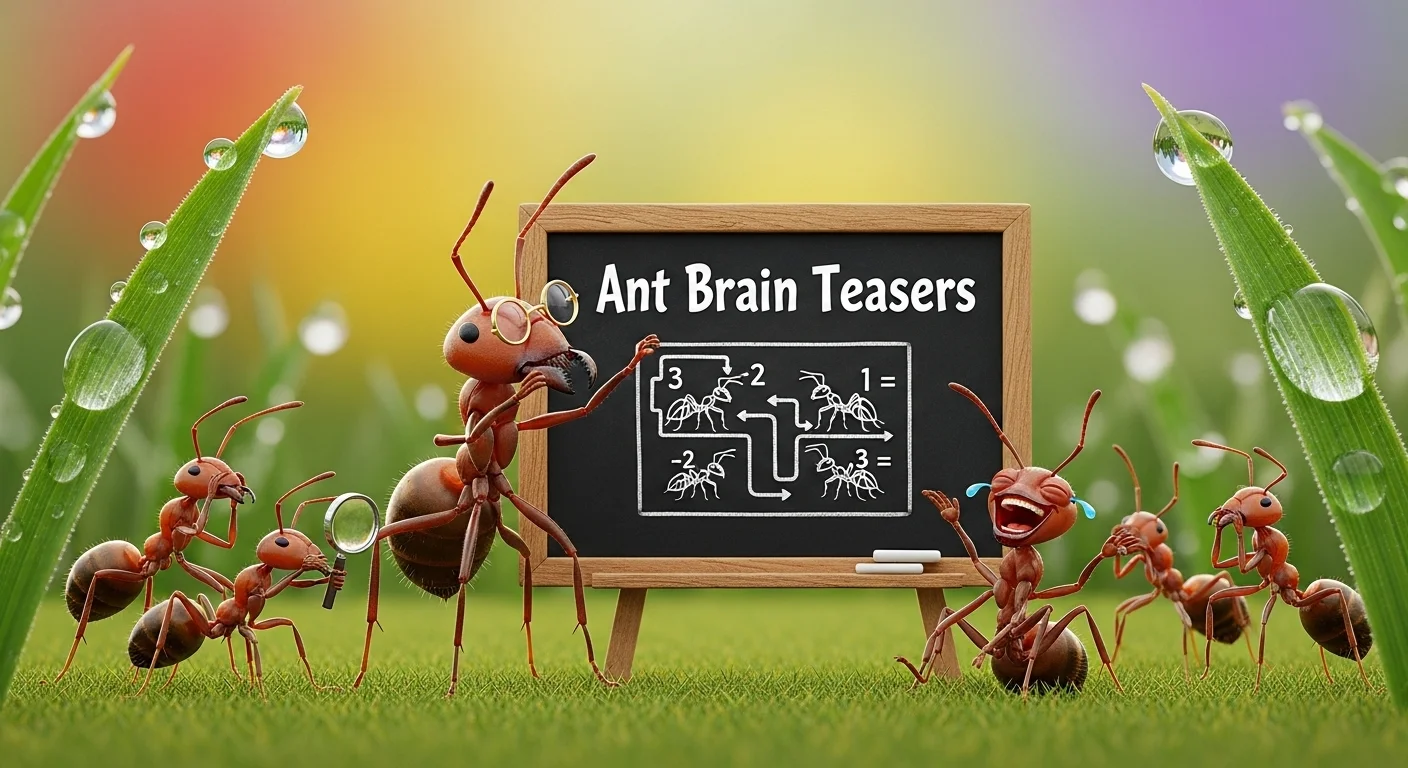
🧩 Tiny Thinkers: Easy ant brain riddles
What kind of ant is always thinking about math? 👉 An account-ant
Which ant likes puzzles the most? 👉 A riddle-ant
Why did the ant sit by the pencil? 👉 To draw a smart plan
What do ants call a memory challenge? 👉 Ant-quiz
How do ants solve mazes? 👉 By following their ant-logic
Which ant can answer questions best? 👉 A brilli-ant
What do ants use to figure things out? 👉 Tiny ant-brains
Why did the ant go to the library? 👉 To read ant-books
How do ants make decisions? 👉 By counting votes
What ant is cleverest at games? 👉 A strateg-ant
🌿 Nature Ant Brain Riddles
Why did the ant cross the leaf bridge carefully? 👉 To avoid wrong turns
How do ants find food in the forest? 👉 By using ant-intuition
Why do ants never forget their homes? 👉 They follow memory trails
What helps ants solve nature puzzles? 👉 Observation skills
How do ants plan their colony path? 👉 By ant-geometry
Why do ants move in lines? 👉 To organize and think efficiently
How do ants know which leaf to lift first? 👉 They calculate strength
What is an ant’s natural GPS? 👉 Pheromone trails
Why do ants avoid obstacles? 👉 They predict patterns
How do ants build tunnels without mistakes? 👉 Team brainstorming
🎓 School Ant Brain Riddles
Why did the ant take notes in class? 👉 To remember tiny details
What subject do ants excel at? 👉 Geometry, for lines and angles
How do ants ace memory games? 👉 By practicing ant-patterns
Why did the ant bring a magnifying glass? 👉 To study small problems
How do ants solve puzzles quickly? 👉 With teamwork
Which ant loves logical thinking? 👉 A cerebr-ant
How do ants check their homework? 👉 Peer review in the colony
Why did the ant study the maze twice? 👉 To learn from mistakes
How do ants remember food locations? 👉 By mental mapping
What do ants do when they solve tricky questions? 👉 Celebrate with tiny cheers
🤔 Thinking Ant Riddles (Mind-Bending)
I lift more than my size yet plan every move 👉 Who am I? Ant
I march in lines but never bump into friends 👉 What am I? Ant formation
I remember trails even after it rains 👉 Who am I? Smart ant
I work with many yet think alone when needed 👉 Who am I? Ant brain
I solve problems faster than I run 👉 What am I? Clever ant
I communicate without speaking a word 👉 Who am I? Ant colony
I can carry food, messages, and wisdom 👉 What am I? Worker ant
I know shortcuts without maps 👉 Who am I? Trail-ant
I think in patterns, not colors 👉 What am I? Ant navigator
I plan the smallest details of my tiny world 👉 Who am I? Ant strategist
🎯 Advanced ant brain riddles Lovers
If 3 ants can lift 12 leaves, how many can 6 ants lift? 👉 24 leaves
An ant leaves the nest at 2 pm, travels 3 meters every 10 minutes. How far by 3 pm? 👉 18 meters
Two ants start from opposite sides of a leaf. If they meet in 5 minutes, how long until they swap positions? 👉 5 minutes
An ant walks in a square tunnel 4 meters per side. How many meters to complete one loop? 👉 16 meters
A colony plans 3 tunnels each 5 meters long. How many meters in total? 👉 15 meters
An ant solves a maze in 10 minutes. If speed doubles, how long? 👉 5 minutes
5 ants share 20 crumbs equally. How many each? 👉 4 crumbs
An ant colony builds 3 chambers with 6 ants each. How many ants total? 👉 18 ants
If an ant lifts 2 grams per trip and makes 10 trips, how much carried? 👉 20 grams
Two ants run races; one is twice as fast. Who finishes first? 👉 The faster ant