education riddles simple are a fun and effective way to help kids learn while playing. These easy brain teasers combine entertainment with knowledge, making it easier for children to understand basic concepts in subjects like math, language, science, and everyday life. Perfect for young learners, classrooms, and homeschooling, these education riddles simple encourage curiosity, improve thinking skills, and make learning enjoyable. With simple questions and clever answers, kids can build confidence while developing problem-solving abilities. Explore this collection of education riddles simple that turn learning into a fun and rewarding experience! ππ
π‘ Did You Know?
Solving simple riddles activates both logic and language areas of the brain at the same time.Students remember lessons better when learning feels playful instead of stressful.
π§ Riddle of the Day
I give you answers but ask first
I make you think and quench your thirst
I live in books and curious minds

π― 100 Easy Riddles with Answers
- What has four legs and barks?
Answer: A dog - What do bees make?
Answer: Honey - What color is the sky on a clear day?
Answer: Blue - What do you drink when youβre thirsty?
Answer: Water - What do you use to write?
Answer: A pencil - What shines at night?
Answer: The moon - What do cows give us?
Answer: Milk - What do you wear on your feet?
Answer: Shoes - What do fish live in?
Answer: Water - What do you call frozen water?
Answer: Ice
π Educational Riddles with Answers
- I help you learn and read, Iβm full of pages. What am I?
Answer: A book - I show you numbers and time. What am I?
Answer: A clock - I help you write on paper. What am I?
Answer: A pen - I am used in school to solve problems. What am I?
Answer: Math - I am a place where students learn. What am I?
Answer: A school - I am a person who teaches you. What am I?
Answer: A teacher - I am something you use to erase mistakes. What am I?
Answer: An eraser - I carry your books to school. What am I?
Answer: A backpack - I am a subject about living things. What am I?
Answer: Biology - I help you see small things. What am I?
Answer: A microscope
π Riddles for Kids
- What has ears but cannot hear?
Answer: Corn - What has a neck but no head?
Answer: A bottle - What has a tail but no body?
Answer: A coin - What has hands but cannot clap?
Answer: A clock - What gets wetter the more it dries?
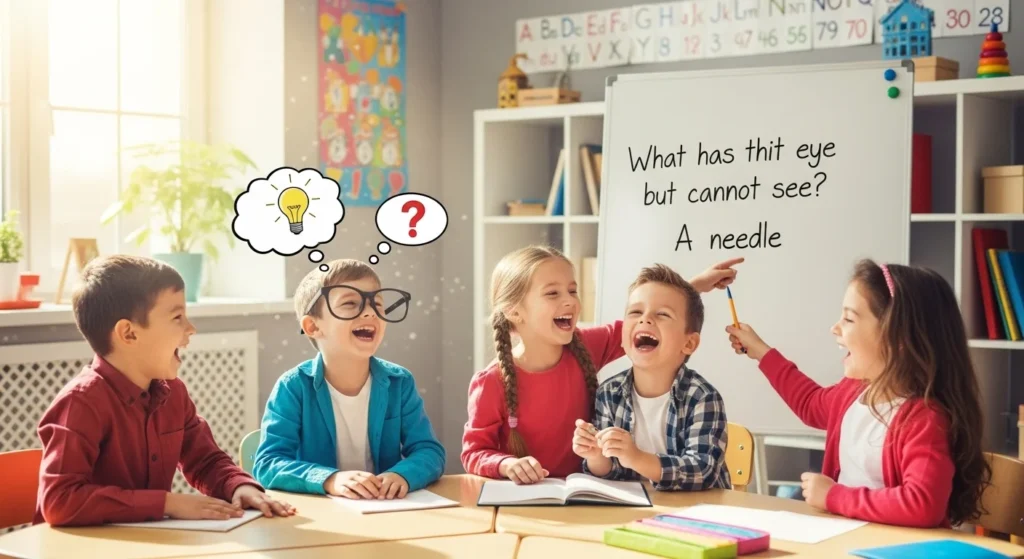
Answer: A towel - What has one eye but cannot see?
Answer: A needle - What runs but never walks?
Answer: Water - What can you catch but not throw?
Answer: A cold - What has many teeth but cannot bite?
Answer: A comb - What goes up but never comes down?
Answer: Your age
π₯ 1000 Riddles with Answers (Sample Set)
- What can travel around the world while staying in one spot?
Answer: A stamp - What has a face but no eyes?
Answer: A clock - What is so fragile that saying its name breaks it?
Answer: Silence - What has cities but no houses?
Answer: A map - What comes down but never goes up?
Answer: Rain - What has one head, one foot, and four legs?
Answer: A bed - What has an eye but cannot see?
Answer: A needle - What begins with P and ends with E and has many letters?
Answer: A post office - What can you hold without touching it?
Answer: Your breath - What has holes but still holds water?
Answer: A sponge
π Simple Riddles for Kids
- What do you eat soup with?
Answer: A spoon - What do you wear on your head?
Answer: A hat - What color are bananas?
Answer: Yellow - What do you brush your teeth with?
Answer: A toothbrush - What do you drink in the morning?
Answer: Milk - What do you open doors with?
Answer: A key - What do you sleep on?
Answer: A bed - What do you see with?
Answer: Your eyes - What do you hear with?
Answer: Your ears - What do you walk with?
Answer: Your legs

πΆ 100 Easy Riddles with Answers for Kids
- What do birds use to fly?
Answer: Wings - What do you wear when it rains?
Answer: A raincoat - What do you call a baby dog?
Answer: A puppy - What do you use to cut paper?
Answer: Scissors - What do you drink from?
Answer: A glass - What do you use to clean your hands?
Answer: Soap - What do you play games on?
Answer: A phone or computer - What do you use to see in the dark?
Answer: A flashlight - What do you sit on?
Answer: A chair - What do you open with a key?
Answer: A lock
π Learning Basics Everyone Knows
What do you gain when you understand something new? π Knowledge
What do you use to think and solve problems? π Brain
What grows every time you practice? π Skill
What helps you remember lessons? π Memory
What happens when you ask why? π Learning
What connects ideas together? π Understanding
What makes school useful? π Education
What improves with reading? π Vocabulary
βοΈ School Tools for Learning
What writes words but never speaks? π Pencil
What fixes mistakes quietly? π Eraser
What holds lessons on paper? π Notebook
What carries books and supplies? π Backpack
What shows lessons to the class? π Board
What keeps papers neat? π Folder
What sharpens pencils quickly? π Sharpener
What helps you read small print? π Glasses

π§βπ« education riddles simple and Teaching
Who explains lessons clearly? π Teacher
Who helps students feel confident? π Teacher
Who answers many questions daily? π Teacher
Who guides learning step by step? π Teacher
Who encourages students to try again? π Teacher
Who writes lessons on the board? π Teacher
Who supports every learner? π Teacher
Who inspires curiosity? π Teacher
π Reading and Writing Skills
What do you do with letters to make words? π Read
What do you use to tell stories? π Writing
What do books help you explore? π Ideas
What skill helps you spell words? π Phonics
What do sentences create together? π Paragraph
What helps you understand stories? π Comprehension
What grows when you read often? π Vocabulary
What makes stories meaningful? π Words
β Numbers and Thinking
What subject uses numbers and counting? π Math
What helps you solve problems? π Logic
What do you add, subtract, and multiply? π Numbers
What shows the answer in math? π Solution
What skill improves with practice? π Calculation
What helps you compare amounts? π Math
What do puzzles strengthen? π Thinking
What do you count every day? π Numbers
π Learning About the World
What subject studies nature and experiments? π Science
What subject explores the past? π History
What subject explains places and maps? π Geography
What helps you learn how things work? π Science
What teaches about people and cultures? π Social Studies
What shows the shape of the Earth? π Globe
What helps you ask questions? π Curiosity
What helps you discover answers? π Learning
π School Day Moments
What starts learning each morning? π School
What break lets students play? π Recess
What meal gives energy midday? π Lunch
What time is for quiet learning? π Study Time
What signals the end of class? π Bell
What ends the school day? π Dismissal
What moment feels shortest? π Fun
What part feels longest? π Waiting
π§© Thinking Games and Practice
What game uses clues and answers? π Riddle
What challenge makes your brain work? π Puzzle
What activity refreshes focus? π Brain Break
What helps learning feel fun? π Game
What do riddles build over time? π Confidence
What grows when students guess? π Curiosity
What helps students stay engaged? π Fun
What makes learning enjoyable? π Play

π€ education riddles simple Values and Habits
What helps students improve over time? π Practice
What helps classmates work together? π Teamwork
What keeps learning kind and fair? π Respect
What helps students listen? π Attention
What makes mistakes okay? π Learning
What helps students succeed? π Effort
What builds confidence? π Encouragement
What keeps students motivated? π Support
β FAQs
What are simple education riddles?
Simple education riddles are easy questions about learning, school, and thinking that help students understand ideas in a fun way. education riddles simple.
Why are education riddles useful?
They boost memory, confidence, and problem-solving skills while keeping learning enjoyable. education riddles simple.
Who can use education riddles?
Teachers, parents, tutors, and students of all ages can use them at school or home. education riddles simple.
When should riddles be used in learning?
They work well as warm-ups, brain breaks, reviews, or fun end-of-lesson activities. education riddles simple.
Are simple riddles good for beginners?
Yes, they are perfect for beginners because they offer quick success and build confidence. education riddles simple.
π Conclusion
Education doesnβt always need long lessons or heavy booksβsometimes, it starts with a single thoughtful question. Simple education riddles simple turn learning into a friendly conversation education riddles simple between curiosity and education riddles simple education riddles simple understanding. They help students think clearly, education riddles simple enjoy mistakes, and feel proud of discovering answers on education riddles simple .